From a Large Patent Portfolio to What Matters Most: A Human-Led, Optimized Approach to SEP Portfolio Prioritization
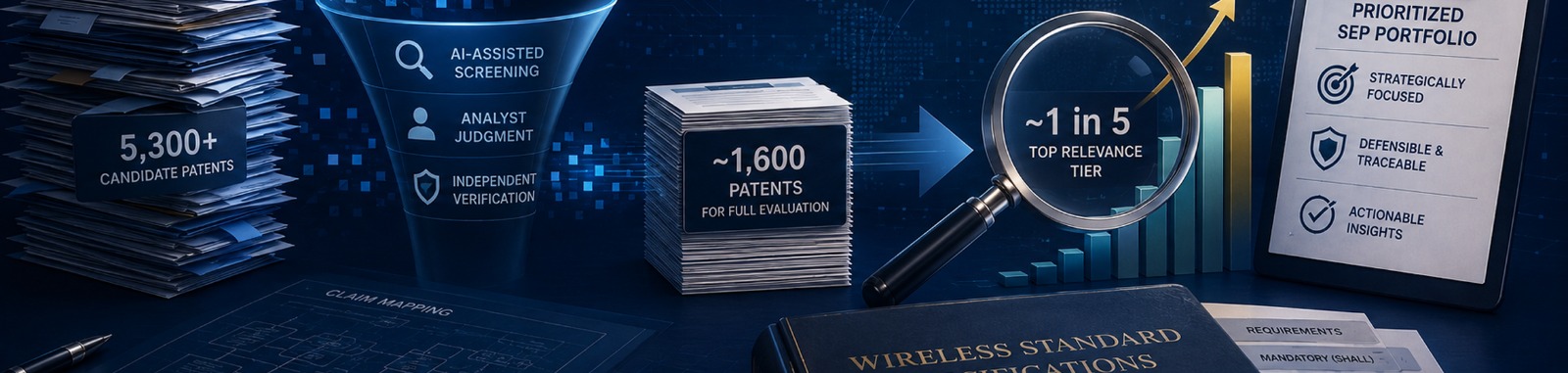
5,300 candidate patents is not a licensing strategy. It's a starting point. Here's how we turned scale into a prioritized, claim-level view a client could act on immediately.
AT A GLANCE
| 5,300+ | ~1,600 | ~1 in 5 |
|---|---|---|
| CANDIDATE PATENTS SCREENED | CARRIED INTO FULL EVALUATION | REACHED TOP RELEVANCE TIER |
Portfolio scale does not require less human judgment. It requires better allocation of human judgment.
When a portfolio contains more than 5,300 patents spanning multiple generations of a rapidly evolving wireless standard, the obvious approach is to review as many patents as possible, as quickly as possible. But for a licensing strategy, reviewing everything at the same depth is not necessarily the most effective approach.
The real question is therefore not:
How can thousands of patents be reviewed as quickly as possible?
It is:
Which patents deserve the most expert attention, and how can that determination be made quickly without compromising the quality and defensibility of the analysis?
That was the challenge in a recent large-scale SEP portfolio evaluation.
The portfolio extended across multiple generations of a wireless connectivity standard and contained patents with different technical roles, ownership histories, jurisdictions, claim structures, and levels of potential relevance to the standard.
The client needed more than a long list of potentially relevant patents. It needed a prioritized view of the portfolio that could support active licensing decisions within a defined timeline.
The answer was not to automate the entire evaluation.
Instead, we structured the project around an optimized workflow in which:
- human experts defined the analytical framework;
- technology handled clearly bounded, high-volume tasks;
- analysts remained responsible for claim interpretation and substantive assessment;
- findings were independently verified before delivery; and
- deeper expert effort was concentrated on the patents with the greatest potential strategic relevance.
The objective was not simply to evaluate more patents in less time.
It was to make sure that specialist time - and ultimately client spend - was concentrated where deeper analysis could create the most value.
THE PROBLEM
5,300 patents sounds like a portfolio. It isn't yet a licensing strategy.
When a portfolio spans multiple generations of a fast-evolving wireless standard, the obvious instinct is to review everything with the same level of attention. That sounds thorough. In practice, it's exactly the wrong instinct.
Some patents will be expired or no longer owned. Some will sit outside the relevant technical scope. Others will look promising at a high level and lose their relevance the moment the independent claim is mapped against the standard. And a smaller group will emerge as the patents that actually deserve a place at the front of a licensing conversation.
The challenge, then, isn't simply finding relevant patents. It's deciding where deeper analysis is worth the time, without letting scale compromise the rigor of the evaluation.
That was the brief a client brought us: a portfolio built over more than a decade, spanning multiple generations of a rapidly evolving wireless connectivity standard, from foundational, long-established features to the newest amendments still being finalized. The portfolio had grown partly through internal filing and partly through acquisition, which meant ownership history mattered almost as much as claim language. What the client needed was simple to describe and difficult to execute: identify the patents with the strongest evidence of standard essentiality, tier them by strategic strength, and do it on a timeline that could support an active licensing conversation, not one that arrived after the conversation had already moved on.
What was in scope
- Technology: multiple successive generations of a single wireless connectivity standard.
- Geography: worldwide coverage.
- Analysis level: individual patent family members, with separate evaluations wherever a patent's independent claims addressed different functional roles.
- Coverage window: currently owned, in-force patents only; expired or lapsed patents were excluded up front.
OUR APPROACH
Scale was useful. But scale alone wasn't enough.
Automation provides scale. Human judgment provides meaning.
Each step in the process serves a different purpose, and what matters most isn't that the checks happen, but that they happen in this order. We first establish which patents genuinely belong in the evaluation universe, then apply a calibrated, consistent claim-level methodology, and finally subject every finding to multiple layers of human verification before anything reaches the client. That sequencing is what keeps a fast first pass from ever becoming the final answer.
FIGURE 1 - THE SIX-STEP EVALUATION WORKFLOW

Step 04 is the only stage in which AI assistance is used at portfolio scale, and it's bracketed on both sides by human judgment.
01 · Validate the portfolio
Before detailed evaluation began, we validated the portfolio to establish the universe of patents that should actually enter the analysis phase. Ownership records, legal status, jurisdictional coverage, and relevant family-member information were checked so that expired, lapsed, no-longer-owned, duplicate, or otherwise out-of-scope records could be removed before analyst time was committed to claim-level work.
This upfront validation mattered because the portfolio had grown through both internal filing and acquisition. Confirming that each patent was both in force and within the client's current ownership ensured the later evaluation was performed on the right assets from the outset.
02 · Calibrate the model
With the evaluation universe established, our team defined the methodology that would be applied consistently across the portfolio: definitions, tagging rules, analytical boundaries, scope, and the required output format.
The AI-assisted process was then tested against a calibration set of patents that analysts had already evaluated manually using their technical understanding of the relevant technology and standard. Where model outputs differed from analyst conclusions, the evaluation rules were refined and the process repeated until results were sufficiently consistent for scaled application. The purpose of calibration was never to replace analyst judgment, but to ensure the AI-assisted stage operated within a clearly defined analytical framework before it touched the wider portfolio.
03 · Anchor the claim
For every patent, an analyst manually identified the broadest independent claim before any AI-assisted evaluation began. This ensured claim selection was based on the analyst's technical and legal judgment, rather than on AI applying vague or inconsistent rules to determine claim breadth.
This is the one step that cannot be automated away as the portfolio grows: every patent must still be reviewed individually. That manual foundation is what makes the subsequent AI-assisted analysis transparent, reproducible, and checkable, rather than merely plausible. Where independent claims addressed materially different functional roles, they were evaluated separately so that potentially relevant subject matter was not lost by treating the patent as a single undifferentiated record.
04 · An optimized workflow: where technology fits
Once the claim has been anchored, the next challenge is scale. Reviewing the relevant provisions across a large and evolving standard manually would require analysts to spend significant time searching before they could begin the substantive assessment. The optimized workflow separates that retrieval task from the judgment that follows. AI assistance helps identify potentially relevant clauses within the applicable standard and reduce the search space that analysts need to review. It does not determine essentiality or make the final claim-to-standard assessment; instead, it surfaces candidate standard provisions for analyst consideration.
Analysts then reviewed those provisions against the claim language, performed the substantive claim-to-standard mapping, and assigned the appropriate relevance and essentiality classifications. This division of work lets technology handle the high-volume retrieval task while interpretation and judgment stay with the analysts.
What should AI do and what should it not do?
AI handles the high-volume retrieval task: identifying potentially relevant provisions and reducing the search space. It does not interpret the claim, determine essentiality, or make the final claim-to-standard assessment. Those decisions remain with the analysts.
05 · Cross-verify and independently review
The initial evaluation was followed by two layers of verification. First, findings were cross-checked against the underlying claim language and relevant standard provisions, with standard-declaration records and litigation or enforcement history reviewed where relevant for additional context on the patent's strategic significance. Declaration records were used to cross-check declaration history, not as a substitute for the claim-level essentiality analysis itself.
Second, approximately 25 to 30% of evaluated patents underwent an additional independent review by a senior reviewer who had not been involved in the original assessment. The reviewer examined not only the assigned classifications, but the rationale behind them, and whether that rationale held up against both the claim language and the relevant portions of the standard.
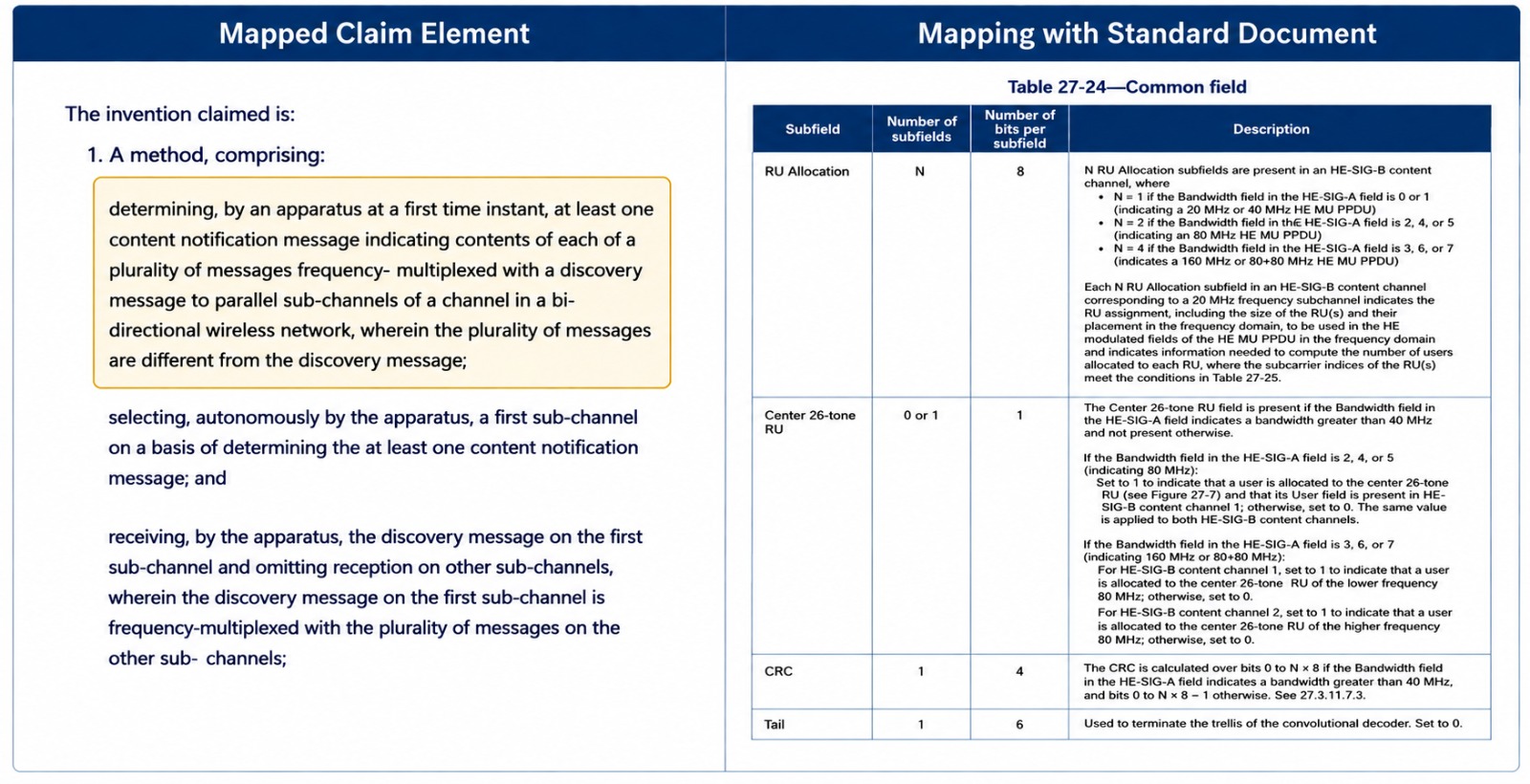
Illustrative Claim-to-Standard Mapping: An anonymized example showing how analyst conclusions remain traceable to both the claim language and the applicable standard provision.
06 · Executive review
Before delivery, the complete evaluation set and client deliverable underwent a final executive review, checking technical neutrality, internal consistency, completeness, and adherence to the agreed methodology across the portfolio, and giving a last opportunity to catch inconsistencies across functional roles, relevance tiers, or analytical rationale before results reached the client.
By the time a finding reached the final report, it had passed through portfolio validation, model calibration, manual claim selection, claim-level evaluation, structured verification, independent review, and executive oversight. The result wasn't simply a large volume of classifications, but a prioritized portfolio in which the underlying reasoning could be traced back to the claim and the standard.
What does an optimized workflow actually change?
The goal is not to remove human review. It is to ensure that expert attention is spent where it matters most: interpreting claims, assessing relevance and essentiality, and verifying findings while repetitive search work is handled more efficiently.
A framework that extends beyond one portfolio
The underlying workflow applies wherever large-scale patent analysis has to combine speed with defensible human judgment. Validating the portfolio first, establishing consistent evaluation criteria, anchoring the analysis in analyst-selected claims, and using AI only for clearly defined supporting tasks creates a process in which every conclusion can be traced back to its analytical basis.
The objective was never to automate judgment, but to use technology to reduce repetitive search effort so that specialist attention could be concentrated on interpretation, verification, and decision-making.
WHY THIS WORKS
The answer wasn't more automation. It was better allocation of judgment.
Not every patent deserves the same depth of review; finding out which ones do is itself the first job. Scale gives consistent first-pass coverage. Judgment decides what the coverage actually means.
The objective was not simply to reduce analyst hours. It was to move analyst hours to where they generated the most value.
FIGURE 2 - TWO CAPABILITIES, ONE DELIVERABLE
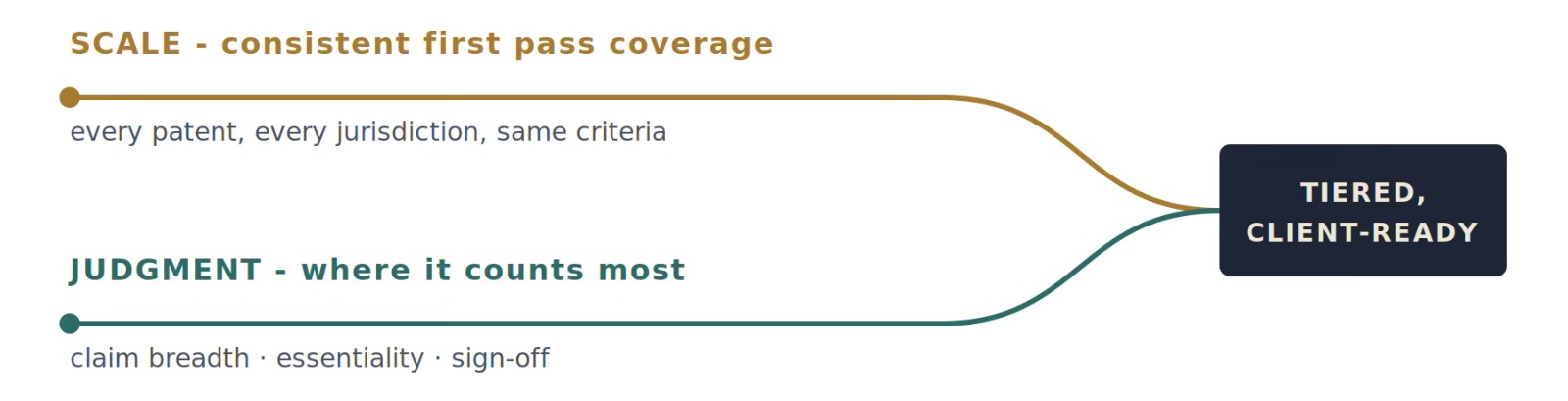
Comprehensive coverage and accurate judgment aren't in tension. The workflow gives each the part of the job it's suited for.
WHY NOT FULLY MANUAL, WHY NOT FULLY AUTOMATED
Manual vs. fully automated vs. our optimized approach
Manual review alone is thorough but doesn't scale on a tight timeline. full automation can provide rapid coverage, but without structured expert verification it may not provide the level of traceability and defensibility required for high-stakes licensing decisions. Our approach is built to get the benefit of both without inheriting either one's weakness.
| MANUAL ONLY | FULLY AUTOMATED | OUR APPROACH | |
|---|---|---|---|
| Speed | Slow - every patent reviewed at the same depth | Fast - full portfolio in a single pass | Fast - effort concentrated where it matters |
| Reliability | High, but inconsistent under time pressure | Rapid, but dependent on subsequent expert verification | Verified - every output checked against the claim |
| Cost | High - expert time spent on every patent equally | Low - but rework costs surface later | Efficient - expert time spent only where it counts |
| Scalability | Breaks down past a few hundred patents | Scales easily - accuracy doesn't | Scales to thousands without losing rigor |
| Client Confidence | Defensible, if the timeline allows it | Hard to stand behind in a negotiation | Defensible and delivered on time |
| Timeline | ~1600-1700 hours | ~100 hours | ~300-350 hours |
THE OUTCOME
The result: fewer patents, sharper priorities.
Approximately 1,600 patents were carried into full evaluation. Because some patents contained independent claims addressing materially different functional roles, the resulting analysis comprised 2,307 claim-level functional-role assessments. Around 1 in 5 reached the portfolio's top relevance tier. This subset is what we recommended the client focus on first, and interestingly, that trend was consistent across all four functional roles involved in the evaluation.
FIGURE 3 - CLAIM-LEVEL ANALYSIS BY FUNCTIONAL ROLE
| 838 | 779 | 586 | 104 |
|---|---|---|---|
| DEVICE-SIDE EVALUATIONS | INFRASTRUCTURE-SIDE EVALUATIONS | GENERAL / CROSS-ROLE EVALUATIONS | DUAL-ROLE EVALUATIONS |
Why the essentiality split matters
The breakdown below shows why the conditional-versus-unconditional distinction mattered in practice. Most of the positively assessed patents were conditionally essential: their claims mapped to the standard only when a specific optional product feature or implementation condition was present. This realization shifted how the client approached its licensing conversations, prompting a start with the smaller set of unconditional patents before moving to the larger group that depended on certain conditions.
FIGURE 4 - ESSENTIALITY BREAKDOWN (POSITIVELY ASSESSED PATENTS)

- A few patents in the portfolio had a history of litigation, providing early indicators of their enforcement value, which influenced our prioritization of the shortlist.
- The strongest concentration of top-tier findings sat in the newest generation of the standard, reflecting where the client's own recent filing activity was already focused.
- The evaluation and review cycle was completed within the client's active licensing timeline, allowing them to use the findings to make informed decisions in their ongoing licensing discussions.
From analysis to action
For large portfolios, the value of evaluation isn't simply determining whether individual patents appear relevant. The greater value comes from creating a structured view of the portfolio: which patents are worth attention first, why they rank more strongly than others, what conditions affect their relevance, and where further technical, licensing, or enforcement analysis may be justified.
That structure is what turns a large collection of patents into a focused basis for strategic decision-making, and it's the same structure we bring to every portfolio we evaluate, regardless of its size or the standard behind it.
WHAT THE CLIENT GAINED
- Prioritized the portfolio: Narrowed a 5,300+ patent portfolio to the patents most relevant for deeper evaluation and licensing attention.
- Focused expert effort where it mattered: Used an optimized workflow to reduce repetitive search effort and concentrate analyst time on claim interpretation, essentiality assessment, and verification.
- Created a defensible basis for licensing: Provided claim-level findings that could be traced back to the relevant patent claims and standard provisions.
- Enabled timely decision-making: Delivered the evaluation within the client’s active licensing timeline, helping them sequence licensing discussions around the strongest opportunities.
THE TAKEAWAY
Large-scale patent analysis does not become more valuable simply because more work is automated.
Its value comes from designing a workflow in which technology and human expertise are each used for the work they are best equipped to perform.
Technology can search, retrieve, organize, and reduce the scale of the problem.
Experienced analysts must still interpret claims, understand technical context, assess essentiality, challenge conclusions, and decide what ultimately matters.
For strategically important portfolio work, that balance is the point.
The objective is not to remove expert judgment from the process. It is to make sure expert judgment is spent where it creates the greatest value - and to help the client reach the patents that matter most, while there is still time to act on them.