When “It’s on the Wayback Machine” Isn’t Enough: The Evidentiary Limitations of Internet Archive Prior Art
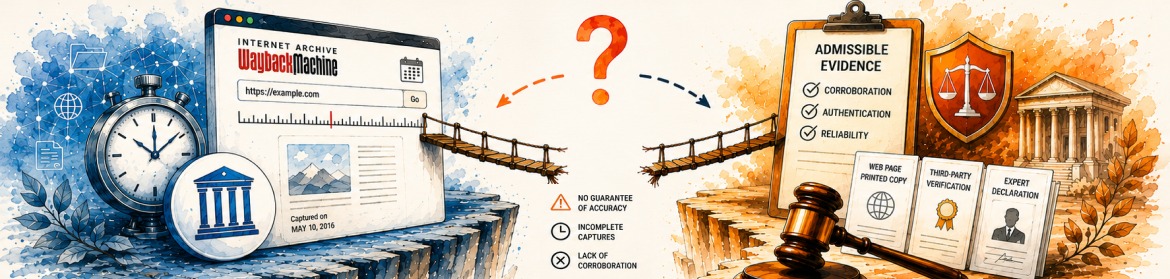
Why a standalone Wayback Machine capture often falls short in an IPR—and how a disciplined prior-art search strengthens the evidentiary record.
Every prior art searcher has felt the pull. You are chasing an invalidity theory, you type a URL into the Wayback Machine, and there it is — a product page, a manual, a feature list captured years before the patent’s priority date, describing exactly the element you need. It looks like a smoking gun. It feels like the case is won. And then, months and many dollars later, the Patent Trial and Appeal Board declines to institute, because the petitioner failed to establish that the archived page qualified as a publicly accessible printed publication before the critical date.
This is one of the most common and most expensive misunderstandings in patent challenges. The Internet Archive's Wayback Machine is an invaluable discovery tool for locating historical web content. Standing alone, however, an archived capture is often insufficient to establish public accessibility or authenticity. At iCuerious, we have spent more than a decade running prior art and invalidity searches, and we have watched otherwise-strong references collapse because they failed to satisfy the evidentiary standards applied by the PTAB and the courts. This article explains why archived web content so often falls short of the standard for valid prior art, walks through the real cases where it did, and shows what a rigorous search does differently.
First principles: what actually counts as prior art
Prior art is any proof that an idea or invention existed before a specific date — usually the day a patent application was filed. Anything published, presented, or otherwise made available to the public can qualify: patents and published applications, scientific journal articles, conference proceedings, product manuals, brochures, websites, and even public demonstrations or sales.
In a patent dispute, prior art is the instrument used to test whether a claimed invention is novel (not previously disclosed to the public) and non-obvious (not an obvious step for someone skilled in the field). But there is a threshold requirement that sits underneath both of those tests and quietly decides most web-based disputes: the reference must have been publicly accessible before the critical date. A document that existed but that no ordinarily skilled person could realistically have found is, legally, not prior art at all — no matter how perfectly it reads on the claims.
The Wayback Machine: powerful for discovery, thin as evidence
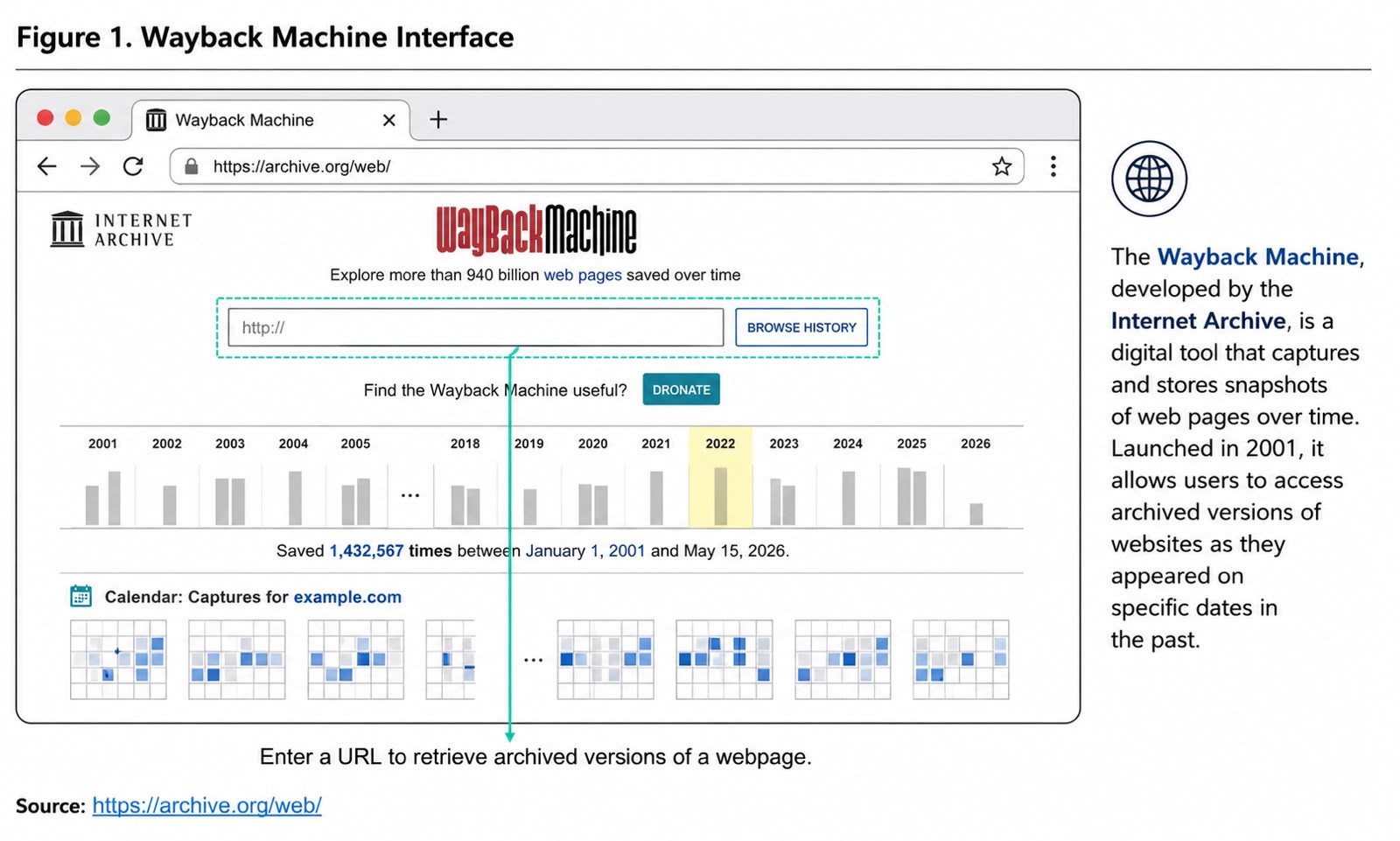
The Wayback Machine, developed by the Internet Archive and launched in 2001, captures and stores snapshots of web pages over time. Enter a URL and you can browse a site as it appeared on a specific date years ago — more than 940 billion pages are preserved. For a searcher, it is often the fastest route to a product page or datasheet that has long since been taken down.
The problem is that everything that makes the Wayback Machine convenient — automated crawling, URL-based retrieval, best-effort captures — also makes it evidentiarily fragile. A snapshot tells you a page was reachable at a URL on a date. It does not, by itself, tell you the page was authentic and unaltered, that its content was genuinely public, that the capture date is reliable, or that anyone skilled in the art could have located it. Those gaps are exactly where invalidity challenges built on archived pages tend to fail.
A distinction that frequently determines the outcome: technical vs. public accessibility
If there is one idea every party relying on archived web evidence needs to internalize, it is this: technical accessibility is not public accessibility.
A document stored on a server and archived by the Wayback Machine is technically accessible if it can be retrieved using the exact URL or archive link. But to be publicly accessible in the eyes of patent law, the document must have been discoverable before the critical date through ordinary means — a search using broad industry terms, or navigation through commonly used repositories — without already knowing the exact file name or URL. Retrieving something because you already know where it lives is not the same as the public being able to find it.
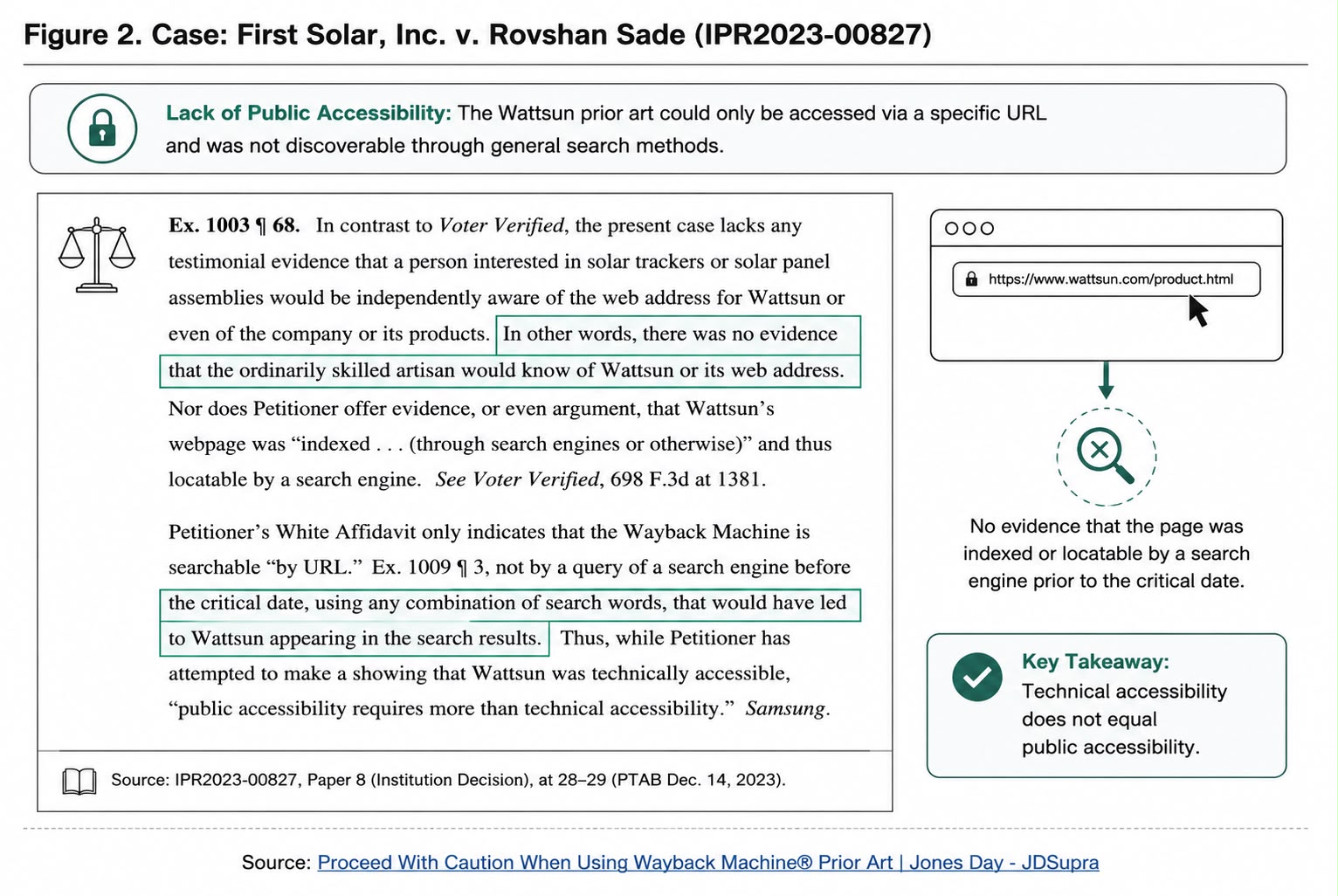
That phrase — “public accessibility requires more than technical accessibility” — is not our slogan. It is the language the Board and the courts use, and it is the reason a searcher can hold a perfect-looking capture in hand and still have nothing that will institute a trial.
Five common evidentiary challenges associated with archived web pages
Across IPRs before the PTAB and disputes in federal court, the same evidentiary weaknesses surface again and again. A party offering a Wayback capture as prior art must be ready to answer for all of them.
1. No verification or testimony
The offering party has to demonstrate that the material was publicly accessible before the critical date, that the page is authentic and unaltered, and that the archival date is accurate and verifiable. A raw screenshot carries none of that — it is an unauthenticated printout, and under Federal Rule of Evidence 901 an unauthenticated document is not what it needs to be to come into evidence.
2. Content volatility
Websites are inherently dynamic. Content is added, edited, deleted, and reorganized constantly, which makes it difficult to conclusively establish the precise state of a page at a given moment in the past without proper controls or version tracking. Wayback Machine captures represent archived snapshots of web content and may not, by themselves, establish a complete or authoritative historical record.
3. Uncertain publication date
The exact date of public disclosure is decisive in determining whether a reference qualifies as prior art. A well-known limitation of archived pages is the inability to conclusively verify the original publication date of the content — the crawl date is not necessarily the date the material first became public. That uncertainty alone can strip the reference of its legal weight.
4. Broken or inaccessible archived links
Admissibility depends on the ability to verify, inspect, and authenticate the content. If an archived link returns a “404 Not Found” error, has been removed due to robots.txt exclusions, fails to load because of broken scripts or missing media, or becomes inaccessible due to server issues or deletions, it cannot be reasonably authenticated by a court or examiner. Its evidentiary value may be significantly reduced unless supported by independent, corroborating documentation or testimony.
5. Existence is not discoverability
A snapshot shows technical existence, not that the content was indexed by major search engines, linked to from other public sites, or otherwise reachable by users. It provides no data on whether the page was actually viewed or accessed by the intended audience — the people skilled in the art. Without external indicators of visibility, a capture proves the page was there, not that the public could find it.
What the case law shows
These are not hypothetical risks. A line of PTAB decisions has turned squarely on the inadequacy of Wayback-sourced references — and, instructively, on what it takes to get them admitted when it is done right.
Client case study: evaluating litigation risk before filing
In one representative engagement (U.S. Patent No. 11,973,731), a client came to us intending to file an inter partes review petition. The primary reference — a set of Mattermost product pages — was sourced from the Wayback Machine and, on its face, explicitly disclosed the claimed group-communication technology. The captures were dated November 2015, comfortably before the critical date. It looked ready to file.
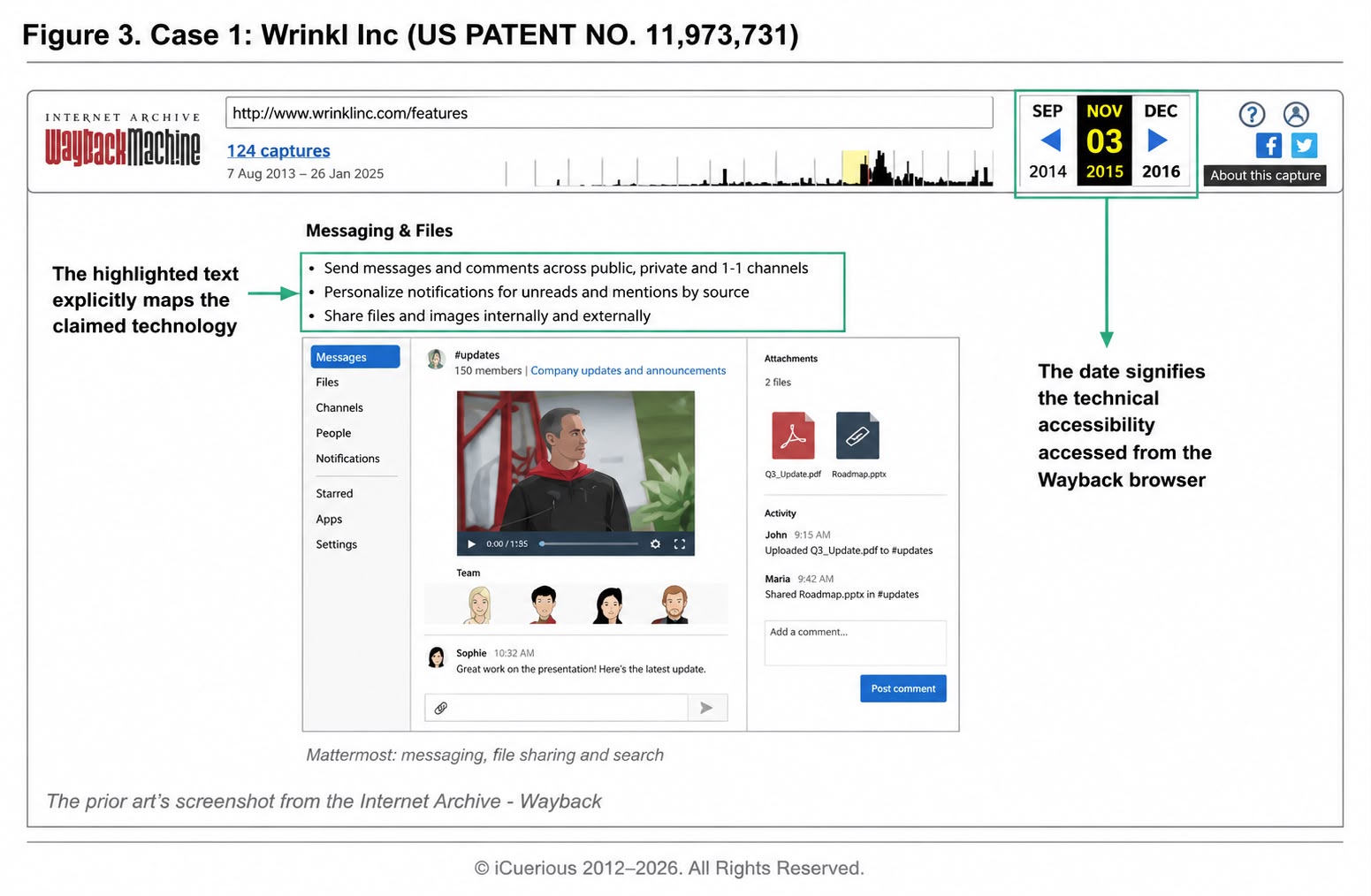
Our analysis flagged the fatal gap. There was no substantiating evidence — no web analytics, no independent citations, no third-party corroboration of the timestamps — to show that the Mattermost pages were indexed, widely disseminated, or accessible to persons skilled in the art as of the relevant date. Consistent with comparable PTAB outcomes, reliance on those Internet Archive references as the primary prior art carried a real risk of the petition being denied institution. We advised the client accordingly, and they made the informed decision not to spend the time and cost of filing on a reference that would likely not survive. Recognizing evidentiary weaknesses before filing can be just as valuable as identifying a technically relevant reference.
First Solar, Inc. v. Rovshan Sade (IPR2023-00827)
The Board denied institution, finding the petitioner had not shown its Wayback-sourced reference (an installation guide for a commercial solar tracker) was publicly accessible prior art. Archiving may have made the document technically accessible as of December 2005, but there was no testimonial evidence that anyone interested in the field would independently know of the product or its web address, and no showing that the page was indexed and locatable by a search engine. The affidavit only established that the page was searchable “by URL” — which, the Board held, is not enough. Public accessibility requires more than technical accessibility.
ServiceNow, Inc. v. Hewlett-Packard Co. (IPR2015-00707)
The Board declined to consider the Wayback Machine evidence as prior art, finding no evidence that the archived page was indexed or discoverable through routine search methods before the critical date, and no showing that the petitioner or anyone else had actually accessed or relied on the page. Where petitioners fail to come forward with credible evidence establishing a key aspect of public availability, the Board has repeatedly denied institution.
When archived evidence does hold up
The lesson is not that Wayback evidence is useless — it is that it has to be built into a properly authenticated record. Two cases show the difference discipline makes.
Sandoz Inc. v. AbbVie Biotechnology Ltd. (IPR2018-00156)
Challenging AbbVie’s patent, Sandoz did not simply hand the Board a screenshot. It submitted a Wayback Machine capture of the 2003 Humira package insert together with a sworn affidavit from Christopher Butler, Office Manager of the Internet Archive, attesting that the printouts were true and accurate copies of the Archive’s records for the specified URLs and dates.
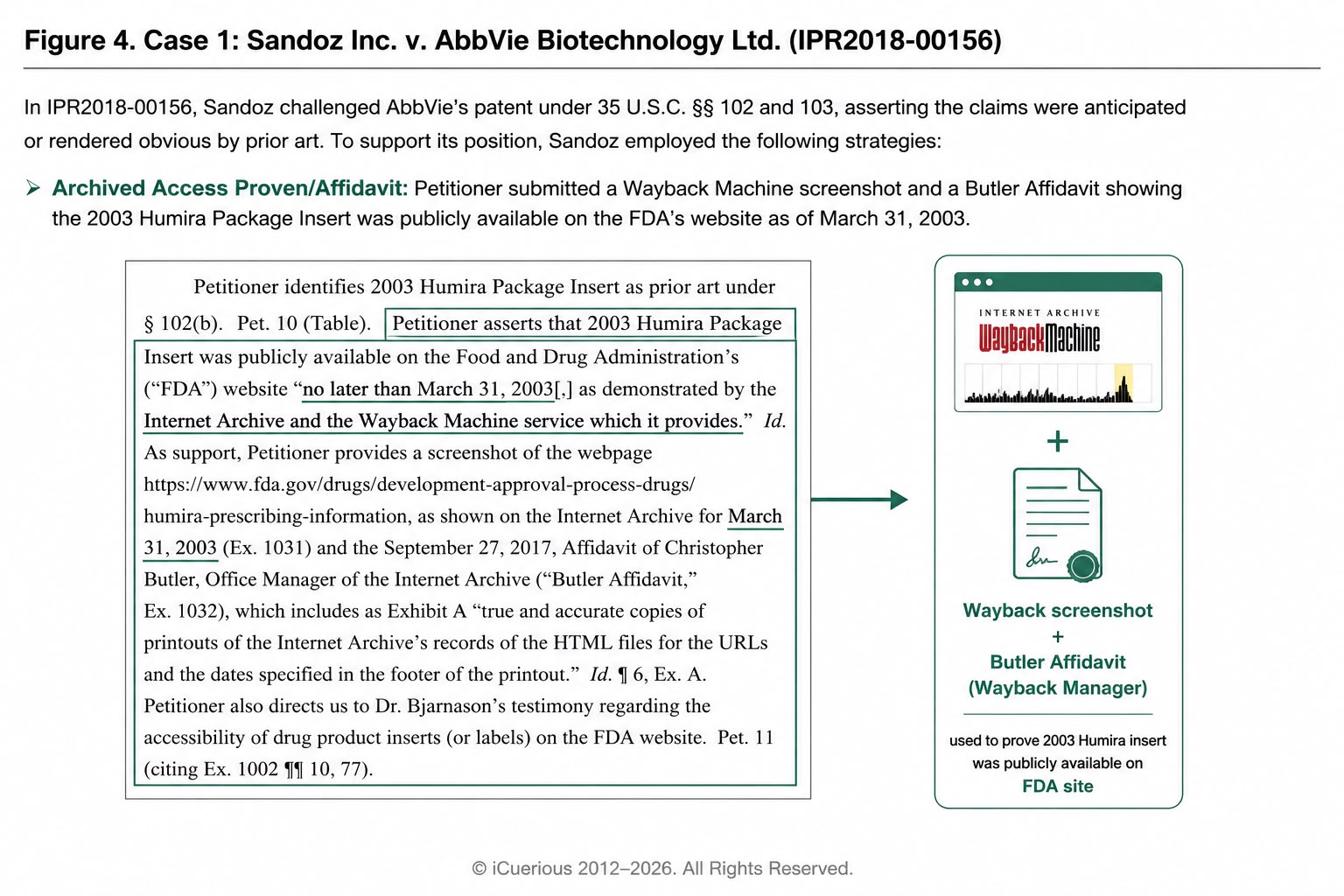
Crucially, Sandoz went further and layered on expert testimony: Dr. Bjarnason testified that in 2003 physicians routinely accessed drug labels on the FDA website and could readily have located the Humira insert using the site’s own search tools. That closed the public-accessibility gap the failed cases left open. The Board credited the unrebutted testimony and found the petitioner had made the threshold showing that the insert was a “printed publication.” Same tool — the Wayback Machine — but supported by an affidavit and independent evidence of genuine public reach.
Johns Manville Corp. v. Knauf Insulation, Inc. (IPR2015-01453)
Here the petitioner supported its Wayback evidence with the standard declaration from the Internet Archive’s Office Manager. When the patent owner sought to depose that witness to challenge reliability, the Board allowed a motion to seek a subpoena but cautioned that it had to be specific and show good cause — noting the Office Manager is a disinterested third party who had already provided a proper attestation. The Board even suggested patent owners think carefully before shouldering the burden of proving inadmissibility rather than arguing the petitioner failed to meet its burden on the merits. The takeaway: a properly authenticated archive record is not trivially knocked out, but archived web evidence remains open to challenge and must be prepared as such.
How a disciplined prior-art investigation strengthens the evidentiary foundation
The pattern across every one of these cases is the same. Finding the content is the easy part; proving its authenticity, date, and public accessibility is the work that determines whether a reference is an asset or a liability. That is where our process is built to add value.
When archived web material is identified, we evaluate whether it is likely to satisfy the public accessibility requirement, identify corroborating evidence, and recommend the most defensible prior-art strategy based on the available evidentiary record:
- Identification of potential authenticating evidence (e.g., affidavits, expert declarations, or contemporaneous supporting records) — sworn statements from people with direct knowledge (authors, librarians, engineers, or the Internet Archive’s Office Manager) establishing when and how the material was made public, admissible under Federal Rules of Evidence 901 and 702.
- Independent, third-party verification — confirmation of authenticity and public accessibility at a specific time, rather than relying on a single editable or best-effort source.
- Assessment of timestamp evidence and alternative methods of establishing publication dates — where the Archive’s own timestamps might be challenged, independent certifications compliant with standards such as RFC 3161-compliant timestamps or other independently verifiable timestamping mechanisms.
- Corroboration across sources — pairing an archived page with academic papers, press releases, blog posts, indexing evidence, or videos that independently support the timing and reach of the disclosure, satisfying the “reasonable public accessibility” standard under 35 U.S.C. § 102.
And, just as importantly, we tell clients when a reference will not hold — before they invest in a petition built on it.
Stronger alternatives to a Wayback capture
Often the most valuable outcome of a search is not authenticating a fragile capture but finding a more robust source for the same disclosure. Where possible, we steer toward references that carry their own proof of public availability:
- Materials with clear publication metadata — institutional repositories (MIT DSpace, arXiv) with DOIs, and peer-reviewed journals and conference proceedings indexed in IEEE Xplore, Springer, or ScienceDirect, which patent offices and courts routinely accept.
- Government publications and standards — ISO, WIPO, NIST, and similar bodies, where an official release date is strong evidence of public availability.
- Code and product repositories — GitHub or GitLab release tags with date-stamped commits and hash-based verification that can prove when a software feature became public.
- DOI-indexed content — sources registered through CrossRef, PubMed, or the ACM Digital Library, where the identifier itself anchors the date and accessibility.
Key takeaways
- Technical accessibility does not equal public accessibility — retrievability by URL is not proof the public could find the content.
- Archived pages must be authenticated through credible testimony or declarations, such as one from an Internet Archive employee.
- The proponent must show the content was publicly accessible, discoverable, and unaltered before the critical date.
- Without proper authentication and corroboration, Wayback evidence may be excluded or afforded limited evidentiary weight.
- Used as a starting point and backed by affidavits, indexing evidence, and corroborating sources, archived material can succeed — as Sandoz v. AbbVie shows. On its own, it usually will not.
Where iCuerious comes in
A prior art search is only as strong as the evidence it can stand on. For over a decade, iCuerious has helped clients distinguish references that merely appear promising from those that are more likely to withstand scrutiny before the USPTO and in litigation. Our role extends beyond identifying archived web content to evaluating its evidentiary strength, assessing public accessibility, identifying corroborating evidence, and recommending the most defensible prior-art strategy.
Talk to the iCuerious Prior Art & Invalidity Search Team → www.icuerious.com
Selected References
- Internet Archive – Wayback Machine (background on the archive itself)
- Federal Rule of Evidence 901 (authentication)
- MPEP § 2128 – Printed Publications as Prior Art
PTAB Decisions
- First Solar v. Rovshan Sade (IPR2023-00827)
- ServiceNow v. Hewlett-Packard (IPR2015-00707)
- Sandoz v. AbbVie (IPR2018-00156)
- Johns Manville v. Knauf Insulation (IPR2015-01453)